
How to Apply for FMLA: Eligibility, Paperwork, and Employer Requirements


Meet the Author

How to Apply for FMLA: Eligibility, Paperwork, and Employer Requirements
Turning to FMLA (Family and Medical Leave Act) means you’re in the middle of something heavy, like a medical diagnosis, a major procedure, or caring for someone you love during a vulnerable time. It can feel like life has paused without warning, leaving you to manage emotional stress, logistics, and now, unfamiliar paperwork. If you feel overwhelmed, nothing about that reaction is a sign you’re unprepared. It’s simply a sign you have a lot to carry right now.
This guide is here to make the process feel lighter and clearer. We’ll walk you through how to apply for FMLA in small, manageable steps.
What you’ll need before you start your FMLA application
The FMLA process works best when you start with a few basics in place. This makes each step smoother and prevents unnecessary back-and-forth later.
First, confirm eligibility. You’ll know if you qualify if:
- You’ve been with your employer for a total of 12 months or more (they don’t have to be back-to-back).
- You’ve worked at least 1,250 hours in the last year.
- Your employer has 50+ staff working within a 75-mile radius of your job location. This is different by state (e.g. California’s CFRA laws means employers with 5+ employees qualify) so make sure to check the specific laws of your state.
If all three apply, you’re likely eligible. If you’re unsure, your employer can confirm your eligibility once you request leave — or you can take our quick pre-qualification quiz to see if you meet the requirements before moving forward.
Next, mark your timeline with dates; they truly matter here. The law allows specific windows for notification, documentation, and employer response. Keeping a few key dates on your phone or calendar can prevent the most common delays.
You’ll also want to gather a few things early, like:
- Your healthcare providers information, or Trust Medical if you’re not working with one currently.
- Any existing medical paperwork you already have
- A general idea of when your leave might start
- How much time off you need
- Your planned leave structure (continuous, intermittent, or a reduced schedule)
- Your company’s leave policy from your employee portal or handbook
Applying for FMLA: Your Quick Reference Checklist
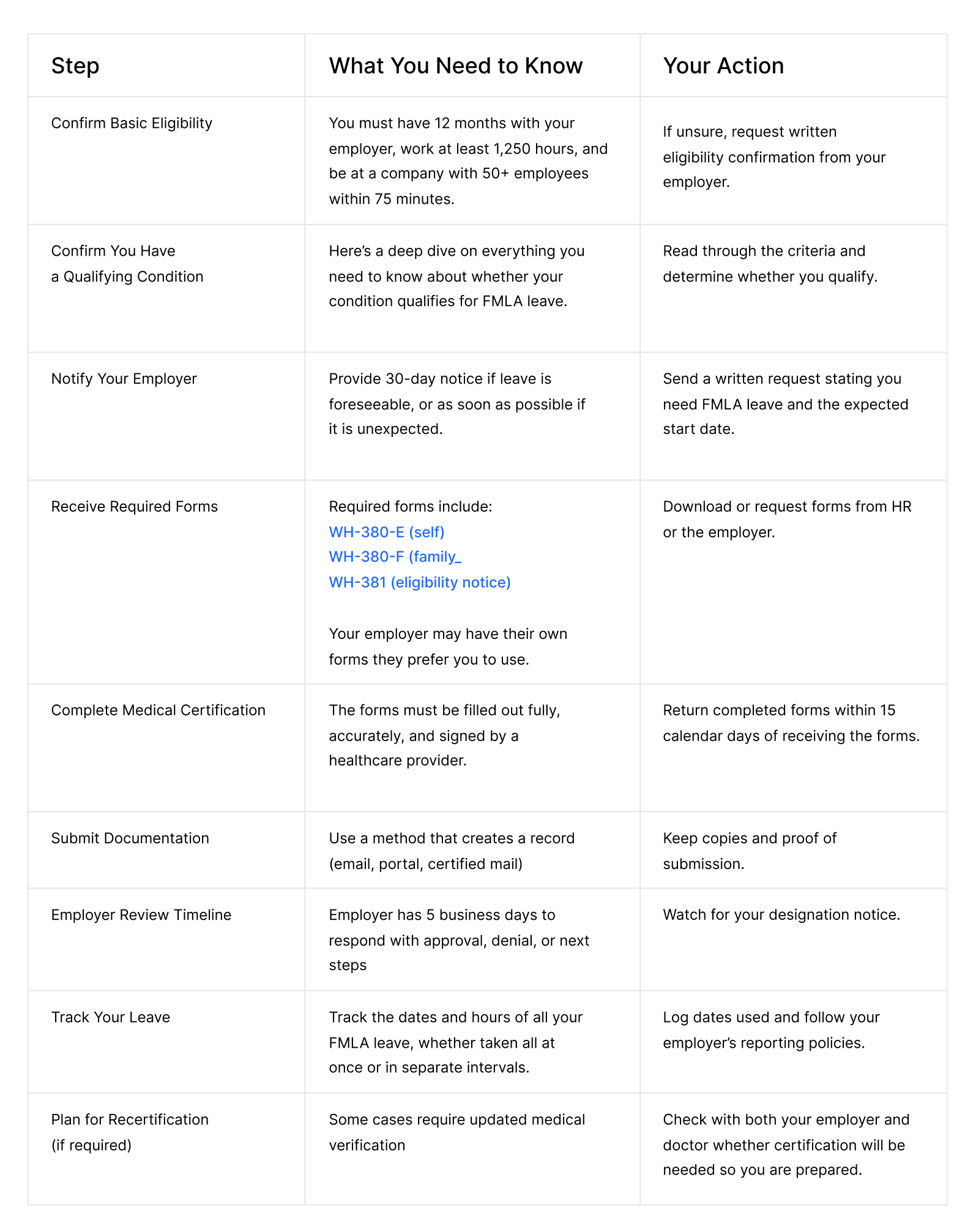
Use this table as a quick FMLA checklist to keep your leave on track. If you need more information on forms, timing, or requirements, check the resources linked below.
Don’t let paperwork slow you down. Take our 3-minute pre-qualification check and get a licensed physician to help you complete your FMLA forms correctly.
Step 1: Notify Your Employer
One of the most stressful parts of the FMLA application process is simply initiating the conversation. Many employees hesitate because they’re unsure how much detail is required or because they’re uncomfortable discussing medical issues at work.
Fortunately, you do not have to disclose medical specifics. You don’t even need a formal diagnosis to start the request. Your notice only needs to communicate three core points:
- You need leave for medical or caregiving reasons.
- You believe it qualifies for FMLA.
- You intend to complete any required paperwork.
If you know about the need in advance, such as a scheduled procedure, maternity leave, or planned treatment, notify your employer 30 days before your leave begins. If your situation is sudden or unexpected, notify them as soon as reasonably possible. This can even be the same day in emergency circumstances.
Here are a few examples you can send to your employer based on your situation:
For personal medical leave:
“I need to request medical leave beginning [date]. I believe this qualifies under FMLA. I will complete all required documentation.”
For caregiving leave:
“I need to take leave to care for an immediate family member with a serious medical condition. I am requesting FMLA leave and will submit the necessary forms.”
For uncertain timing:
“I need medical leave, but I’m still confirming dates with my provider. I’m initiating my FMLA request and will supply details and paperwork as soon as possible.”
Who Should You Notify?
If your company has HR, include them. If you’re unsure, notify both your direct supervisor and HR in writing. Even if you speak to someone in person, always follow up with a short email to create a written record.
Step 2: Get the Right Forms

Once your employer is notified, paperwork begins. The forms can look intimidating, but there are only a few core documents used in most cases:
Form WH-380-E: For your own serious health condition
Form WH-380-F: For a family member’s serious health condition
Form WH-381: Your employer’s notice of eligibility and rights
These forms come from the U.S. Department of Labor and are standard nationwide. Many employers may also require company-specific forms, so be sure to ask your HR department or supervisor exactly which forms you need to complete.
You can get official FMLA documents from:
- The U.S. Department of Labor website
- Your HR department or company leave portal
- Your employer’s leave administrator, if they use a third-party provider
Digital submissions are typically acceptable, but not always. Some employers allow email or upload portals, while others request printed copies. If you’re unsure, check the policy.
Step 3: Complete Medical Certification
This step carries the most weight in the entire FMLA application process, and it’s where many people experience delays. It’s not because they aren’t eligible, but because certifications must meet very specific criteria.
Once your employer provides the certification form, you typically have 15 calendar days to return it. That window closes quickly, especially when you’re coordinating appointments or waiting on providers.
Your medical provider must include:
- Confirmation that you have a qualifying condition
- Date the condition began or will begin
- Probable duration of the condition
- Treatment plan, including medication, therapy, or other medical care you’re receiving
- Job impact, specifying which job functions you cannot perform due to this condition
- Whether the leave should be continuous, intermittent, or on a reduced schedule
- Follow-up appointment date, if needed
- Provider contact information and signature
It’s important to understand that approval of the leave request is administrative, but the confirmation of medical need comes from a doctor. Only a qualified healthcare provider can assess your condition and certify the level and duration of care required.
Once your provider fills out the form, review it before submission. Look for blank fields, approximate dates without ranges, or missing signatures. Ask the clinic staff the best way to follow up in case revisions are needed.
What If Your Doctor Declines?
This is more common than many realize for a few reason:
- Providers are busy and admin paperwork takes a long time
- Many are unfamiliar with FMLA forms and won’t complete it if they’re not comfortable
- Often they are unclear on what’s required and fill it out incorrectly
When this happens, employees are often stuck waiting, delaying, or starting over.
Trust Medical can help you get your FMLA forms completed:
This is also where the right support system makes the biggest difference. At Trust Medical, we streamline the medical certification process so you don’t have to navigate paperwork alone. Our licensed physicians understand FMLA requirements in detail, complete documentation accurately, and eliminate avoidable back-and-forth. Our role is to handle this step clearly, promptly, and correctly so your leave request can move forward without unnecessary delays.
Ready to simplify your FMLA request? Take our 3-minute pre-qualification check and get connected with a licensed physician today.
Step 4: Submit and Track Your Case

Once your forms are ready, submit them using a method that leaves a record. For example:
- Email with a read receipt
- Company portal upload confirmation
- Certified mail if paper forms are required
Note: Only hand-deliver forms if you receive written confirmation of receipt.
After submission, your employer has five business days to respond with an eligibility notice or request for more information. Their response should clarify whether:
- Your leave is approved.
- More information is needed.
- Your certification requires follow-up.
If approved, you’ll receive a designation notice confirming leave type, start date, duration, and whether recertification will be required later. Some employees are approved for intermittent leave, meaning non-consecutive days or hours rather than a single continuous block. If so, track your leave dates carefully. Intermittent requests are often reviewed more closely.
How to Apply for FMLA: Eligibility, Paperwork, and Employer Requirements
Turning to FMLA (Family and Medical Leave Act) means you’re in the middle of something heavy, like a medical diagnosis, a major procedure, or caring for someone you love during a vulnerable time. It can feel like life has paused without warning, leaving you to manage emotional stress, logistics, and now, unfamiliar paperwork. If you feel overwhelmed, nothing about that reaction is a sign you’re unprepared. It’s simply a sign you have a lot to carry right now.
This guide is here to make the process feel lighter and clearer. We’ll walk you through how to apply for FMLA in small, manageable steps.
What you’ll need before you start your FMLA application
The FMLA process works best when you start with a few basics in place. This makes each step smoother and prevents unnecessary back-and-forth later.
First, confirm eligibility. You’ll know if you qualify if:
- You’ve been with your employer for a total of 12 months or more (they don’t have to be back-to-back).
- You’ve worked at least 1,250 hours in the last year.
- Your employer has 50+ staff working within a 75-mile radius of your job location. This is different by state (e.g. California’s CFRA laws means employers with 5+ employees qualify) so make sure to check the specific laws of your state.
If all three apply, you’re likely eligible. If you’re unsure, your employer can confirm your eligibility once you request leave — or you can take our quick pre-qualification quiz to see if you meet the requirements before moving forward.
Next, mark your timeline with dates; they truly matter here. The law allows specific windows for notification, documentation, and employer response. Keeping a few key dates on your phone or calendar can prevent the most common delays.
You’ll also want to gather a few things early, like:
- Your healthcare providers information, or Trust Medical if you’re not working with one currently.
- Any existing medical paperwork you already have
- A general idea of when your leave might start
- How much time off you need
- Your planned leave structure (continuous, intermittent, or a reduced schedule)
- Your company’s leave policy from your employee portal or handbook
Applying for FMLA: Your Quick Reference Checklist
Use this table as a quick FMLA checklist to keep your leave on track. If you need more information on forms, timing, or requirements, check the resources linked below.
Don’t let paperwork slow you down. Take our 3-minute pre-qualification check and get a licensed physician to help you complete your FMLA forms correctly.
Step 1: Notify Your Employer
One of the most stressful parts of the FMLA application process is simply initiating the conversation. Many employees hesitate because they’re unsure how much detail is required or because they’re uncomfortable discussing medical issues at work.
Fortunately, you do not have to disclose medical specifics. You don’t even need a formal diagnosis to start the request. Your notice only needs to communicate three core points:
- You need leave for medical or caregiving reasons.
- You believe it qualifies for FMLA.
- You intend to complete any required paperwork.
If you know about the need in advance, such as a scheduled procedure, maternity leave, or planned treatment, notify your employer 30 days before your leave begins. If your situation is sudden or unexpected, notify them as soon as reasonably possible. This can even be the same day in emergency circumstances.
Here are a few examples you can send to your employer based on your situation:
For personal medical leave:
“I need to request medical leave beginning [date]. I believe this qualifies under FMLA. I will complete all required documentation.”
For caregiving leave:
“I need to take leave to care for an immediate family member with a serious medical condition. I am requesting FMLA leave and will submit the necessary forms.”
For uncertain timing:
“I need medical leave, but I’m still confirming dates with my provider. I’m initiating my FMLA request and will supply details and paperwork as soon as possible.”
Who Should You Notify?
If your company has HR, include them. If you’re unsure, notify both your direct supervisor and HR in writing. Even if you speak to someone in person, always follow up with a short email to create a written record.
Step 2: Get the Right Forms
Once your employer is notified, paperwork begins. The forms can look intimidating, but there are only a few core documents used in most cases:
Form WH-380-E: For your own serious health condition
Form WH-380-F: For a family member’s serious health condition
Form WH-381: Your employer’s notice of eligibility and rights
These forms come from the U.S. Department of Labor and are standard nationwide. Many employers may also require company-specific forms, so be sure to ask your HR department or supervisor exactly which forms you need to complete.
You can get official FMLA documents from:
- The U.S. Department of Labor website
- Your HR department or company leave portal
- Your employer’s leave administrator, if they use a third-party provider
Digital submissions are typically acceptable, but not always. Some employers allow email or upload portals, while others request printed copies. If you’re unsure, check the policy.
Step 3: Complete Medical Certification
This step carries the most weight in the entire FMLA application process, and it’s where many people experience delays. It’s not because they aren’t eligible, but because certifications must meet very specific criteria.
Once your employer provides the certification form, you typically have 15 calendar days to return it. That window closes quickly, especially when you’re coordinating appointments or waiting on providers.
Your medical provider must include:
- Confirmation that you have a qualifying condition
- Date the condition began or will begin
- Probable duration of the condition
- Treatment plan, including medication, therapy, or other medical care you’re receiving
- Job impact, specifying which job functions you cannot perform due to this condition
- Whether the leave should be continuous, intermittent, or on a reduced schedule
- Follow-up appointment date, if needed
- Provider contact information and signature
It’s important to understand that approval of the leave request is administrative, but the confirmation of medical need comes from a doctor. Only a qualified healthcare provider can assess your condition and certify the level and duration of care required.
Once your provider fills out the form, review it before submission. Look for blank fields, approximate dates without ranges, or missing signatures. Ask the clinic staff the best way to follow up in case revisions are needed.
What If Your Doctor Declines?
This is more common than many realize for a few reason:
- Providers are busy and admin paperwork takes a long time
- Many are unfamiliar with FMLA forms and won’t complete it if they’re not comfortable
- Often they are unclear on what’s required and fill it out incorrectly
When this happens, employees are often stuck waiting, delaying, or starting over.
Trust Medical can help you get your FMLA forms completed:
This is also where the right support system makes the biggest difference. At Trust Medical, we streamline the medical certification process so you don’t have to navigate paperwork alone. Our licensed physicians understand FMLA requirements in detail, complete documentation accurately, and eliminate avoidable back-and-forth. Our role is to handle this step clearly, promptly, and correctly so your leave request can move forward without unnecessary delays.
Ready to simplify your FMLA request? Take our 3-minute pre-qualification check and get connected with a licensed physician today.
Step 4: Submit and Track Your Case
Once your forms are ready, submit them using a method that leaves a record. For example:
- Email with a read receipt
- Company portal upload confirmation
- Certified mail if paper forms are required
Note: Only hand-deliver forms if you receive written confirmation of receipt.
After submission, your employer has five business days to respond with an eligibility notice or request for more information. Their response should clarify whether:
- Your leave is approved.
- More information is needed.
- Your certification requires follow-up.
If approved, you’ll receive a designation notice confirming leave type, start date, duration, and whether recertification will be required later. Some employees are approved for intermittent leave, meaning non-consecutive days or hours rather than a single continuous block. If so, track your leave dates carefully. Intermittent requests are often reviewed more closely.
What Usually Slows Down FMLA Approval
Most delays happen not because a leave request is invalid, but because of small errors. Here are the most frequent pitfalls:
- Missing the 15-day certification window
- Submitting incomplete medical forms
- Assuming verbal notice was sufficient without written confirmation
- Providing more medical information than requested
- Losing copies of submitted documents
- Assuming approval is automatic
- Not tracking intermittent leave usage accurately
None of these are permanent mistakes, but they can extend processing time during moments when you need a resolution quickly.
What Usually Slows Down FMLA Approval
Most delays happen not because a leave request is invalid, but because of small errors. Here are the most frequent pitfalls:
- Missing the 15-day certification window
- Submitting incomplete medical forms
- Assuming verbal notice was sufficient without written confirmation
- Providing more medical information than requested
- Losing copies of submitted documents
- Assuming approval is automatic
- Not tracking intermittent leave usage accurately
None of these are permanent mistakes, but they can extend processing time during moments when you need a resolution quickly.

What Happens if Your FMLA Request is Denied?
A denial is not the end of the road. Employers must provide a reason, and many of the common causes are fixable. You also have the right to submit an updated certification or request a second medical opinion. If discrepancies continue and impact your ability to take protected leave, legal consultation may be appropriate. However, most situations are resolved long before that step becomes necessary.
What Happens if Your FMLA Request is Denied?
A denial is not the end of the road. Employers must provide a reason, and many of the common causes are fixable. You also have the right to submit an updated certification or request a second medical opinion. If discrepancies continue and impact your ability to take protected leave, legal consultation may be appropriate. However, most situations are resolved long before that step becomes necessary.

A Clear, Supported Path Forward
Applying for FMLA during a stressful season can feel like managing logistics with no margin for error. The process is detailed, but it isn’t impossible, and you don’t have to let paperwork slow down the support you need.
When you search how to file for FMLA, you’re really searching for clarity, confidence, and momentum. What makes the biggest difference isn’t only knowing the steps. It’s having support during the most documentation-heavy parts, especially medical certification.
That’s where Trust Medical steps in. We simplify the hardest part of requesting FMLA leave by ensuring your medical certification is completed accurately, efficiently, and in full alignment with federal requirements. No unnecessary delays or ambiguous forms. You don’t even have to worry about missed deadlines.
Take the Next Step with Confidence
Skip the guesswork of locating a doctor and figuring out your leave requirements. Complete our 3-minute pre-qualification check to see where you stand and get connected with a licensed physician who can help with your FMLA request. Start your application today.
A Clear, Supported Path Forward
Applying for FMLA during a stressful season can feel like managing logistics with no margin for error. The process is detailed, but it isn’t impossible, and you don’t have to let paperwork slow down the support you need.
When you search how to file for FMLA, you’re really searching for clarity, confidence, and momentum. What makes the biggest difference isn’t only knowing the steps. It’s having support during the most documentation-heavy parts, especially medical certification.
That’s where Trust Medical steps in. We simplify the hardest part of requesting FMLA leave by ensuring your medical certification is completed accurately, efficiently, and in full alignment with federal requirements. No unnecessary delays or ambiguous forms. You don’t even have to worry about missed deadlines.
Take the Next Step with Confidence
Skip the guesswork of locating a doctor and figuring out your leave requirements. Complete our 3-minute pre-qualification check to see where you stand and get connected with a licensed physician who can help with your FMLA request. Start your application today.
Get FMLA or Paid Leave In 24 Hours



250K+


Still have questions? Find answers here:
We offer the following services:- Intermittent FMLA Certification
- Continuous FMLA Certification
- Reduced Schedule FMLA Certification
- Return to Work Forms
We do not support the following services:
- Disability claimsEach service requires a 15-minute video consultation with one of our board-certified physicians.
People trust us. We recognize the importance of your job and your academic standing, which is why we adhere to the highest standards of integrity and ensure we're fully compliant.Additionally, we know this process can be anxiety inducing, which is why we take pride on our customer support and we make it extremely easy to speak to us and help you get your issues resolved.We believe so much in what we do that we offer an 100% money back guarantee.All of our doctors credentials are public and easily verifiable. Additionally, all of our certifications & evaluations are completed to the highest standard and contain all the details your employer needs to feel confident.We set the standard for FMLA certifications.
Here’s the step-by-step process:Complete the medical intake: This is a short form that helps us expedite your consult.Book a 15-minute video appointment: Choose a time that works for you.Attend your video consultation: During the 15-minute video visit, the doctor will discuss your condition, and treatment options if needed.Receive your paperwork: Your completed certification paperwork will be provided to you in our secure portal within 72 hours of the video visit.
There is an initial $50 booking fee to secure your appointment. The remaining balance will be charged after your video consultation.
Yes! If you have not yet been diagnosed, our board-certified physicians will discuss your symptoms and provide treatment options during the video consultation. Based on the findings, a follow-up appointment may be recommended in 2-4 weeks.
No, our services are self-pay only. We do not bill insurance providers, and all payments are made out of pocket. We strive to keep our prices transparent and affordable.
Your completed certification paperwork will provided to you via email within 24 hours after your video visit. You will have 24/7 access to this information.
Follow-up video appointments are available for $75.00. Your physician may also recommend a follow-up in 2-4 weeks if you are needing management of your condition(s).
To book an appointment, simply visit our website, complete the intake, pay a $50 deposit to reserve your spot, and schedule your 15-minute video consultation with one of our Board-Certified physicians. After booking, you’ll receive an email with further instructions, including the intake form and portal registration.
Employers can verify certifications through our provider contact information. The verification process confirms the authenticity of the forms while maintaining your medical privacy under HIPAA regulations. The verification service is available during business hours from 8am-8pm, Monday through Sunday.
FMLA leave can be used for:- Birth and care of a newborn child.- Adoption or foster care placement of a child.- Care for a spouse, child, or parent with a serious health condition.- The employee’s own serious health condition that prevents them from attending work.
No, FMLA itself is unpaid. However, you can use accrued PTO, sick leave, or vacation days during FMLA. Some states (California, New York, New Jersey, Rhode Island, Washington) have separate paid family leave programs. You might also qualify for short-term disability benefits through your employer. Trust Medical does not work with disability, but can help with any federal or state level FMLA requests.
Up to 12 weeks in a 12-month period for most qualifying reasons. Military caregivers can take up to 26 weeks. You can take it all at once, or intermittently (a few days/hours at a time) for chronic conditions. The 12 weeks resets based on your employer's chosen method (calendar year, your anniversary, etc.).
Yes. Anxiety, depression, PTSD, and other mental health conditions qualify if they meet the "serious health condition" criteria—meaning you need continuing treatment from a healthcare provider. This includes conditions requiring medication, regular therapy, or that prevent you from working for 3+ days.
Take our pre-qualification quiz to see if your mental health condition qualifies for FMLA.
250K+

Money Back Guarantee!
Related posts