
What Conditions Qualify for FMLA Leave?


Meet the Author

What Conditions Qualify for FMLA Leave?
Disclaimer: This article is meant to help you understand FMLA, but it's not medical or legal advice. Every situation is different, so it's always best to talk with your doctor or an employment lawyer about your specific circumstances.
Wondering if your specific health situation qualifies for FMLA protection?
You're not alone.
Thousands of employees face this question every year when dealing with their own medical challenges or caring for loved ones.
The uncertainty can be stressful:
- Will you lose your job if you need time off?
- Does your condition even count?
- What if your employer says no?
The Family and Medical Leave Act (FMLA) covers a wide range of medical situations, both expected and unexpected:
- Cancer treatment
- Anxiety disorders
- Pregnancy complications
- Caring for a parent after surgery
- Much more
If it's a serious health condition that requires time away from work, it likely qualifies.
Table of Contents
- Do You Qualify? The Simple Test
- What Qualifies as a Serious Health Condition?
- Category 1: Your Own Serious Health Condition
- Category 2: Caring for a Family Member
- Category 3: Birth and Bonding with a New Child
- Category 4: Military Family Leave
- What Does NOT Qualify for FMLA
- How to Get Your Condition Certified for FMLA
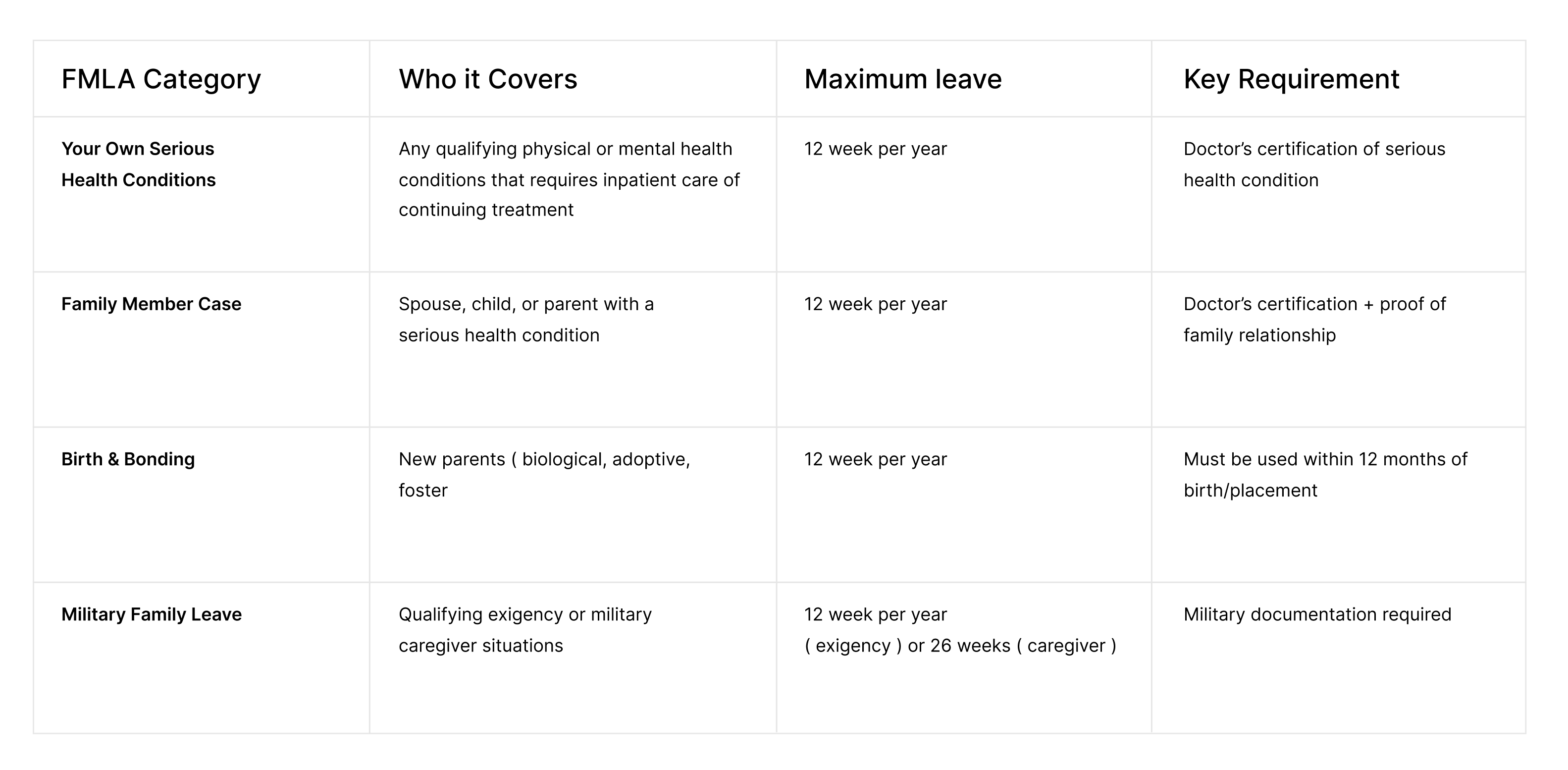
4 Ways to Qualify for FMLA Leave
Do You Qualify for FMLA Leave? The Simple Test
Answer these 2 questions:
- Can you do your job?
- YES → You don't qualify
- NO → Your health condition prevents or prevented you from performing your job duties
- Do you meet one of the qualifying health conditions?
- YES → You meet one of the above four criteria.
- NO → You don’t qualify
Ready to get certified? Take our free 3-minute quiz to see if you qualify.
What Conditions Qualify for FMLA Leave?
Disclaimer: This article is meant to help you understand FMLA, but it's not medical or legal advice. Every situation is different, so it's always best to talk with your doctor or an employment lawyer about your specific circumstances.
Wondering if your specific health situation qualifies for FMLA protection?
You're not alone.
Thousands of employees face this question every year when dealing with their own medical challenges or caring for loved ones.
The uncertainty can be stressful:
- Will you lose your job if you need time off?
- Does your condition even count?
- What if your employer says no?
The Family and Medical Leave Act (FMLA) covers a wide range of medical situations, both expected and unexpected:
- Cancer treatment
- Anxiety disorders
- Pregnancy complications
- Caring for a parent after surgery
- Much more
If it's a serious health condition that requires time away from work, it likely qualifies.
Table of Contents
- Do You Qualify? The Simple Test
- What Qualifies as a Serious Health Condition?
- Category 1: Your Own Serious Health Condition
- Category 2: Caring for a Family Member
- Category 3: Birth and Bonding with a New Child
- Category 4: Military Family Leave
- What Does NOT Qualify for FMLA
- How to Get Your Condition Certified for FMLA
4 Ways to Qualify for FMLA Leave
Do You Qualify for FMLA Leave? The Simple Test
Answer these 2 questions:
- Can you do your job?
- YES → You don't qualify
- NO → Your health condition prevents or prevented you from performing your job duties
- Do you meet one of the qualifying health conditions?
- YES → You meet one of the above four criteria.
- NO → You don’t qualify
Ready to get certified? Take our free 3-minute quiz to see if you qualify.
Category 1: Your Own Serious Health Condition
This is the most common reason people use FMLA leave, and here's the key thing to understand: FMLA eligibility isn't based on your specific diagnosis. Instead, it's based on whether your condition meets certain medical criteria.
Does Your Condition Meet the Criteria? Check These 5 Pathways
If your condition meets any ONE of these criteria, it qualifies for FMLA:
1. Inpatient Care
What it means: Overnight stay in a hospital, psychiatric facility, nursing home, or hospice care
Examples: Surgery requiring hospitalization, mental health crisis requiring admission, serious injury needing hospital stay
2. Three+ Days Unable to Work (Most Common Path)
What it means: You need ALL three of these:
- Unable to work for 3+ consecutive days
- Saw a healthcare provider within 7 days of symptoms starting
- Either: had a follow-up visit within 30 days OR were prescribed ongoing treatment (medication, therapy, monitoring)
Examples: Major depressive episode with treatment plan, major anxiety episode with treatment plan, severe flu with prescription medication, back injury requiring physical therapy, severe migraine with prescribed treatment
3. Chronic Condition
What it means: You see a doctor 2+ times per year for this ongoing condition
Examples: Generalized anxiety disorder, major depressive disorder, diabetes requiring management, epilepsy with medication, severe asthma needing regular care, chronic migraines, bipolar disorder.
4. Ongoing Medical Treatments
What it means: Regular treatments that would be dangerous or ineffective to skip
Examples: Chemotherapy, dialysis, radiation, infusion treatments, physical therapy for serious conditions
5. Long-Term or Permanent Conditions
What it means: Permanent or long-term condition with no cure, requiring ongoing medical supervision (even if not actively treating)
Examples: Alzheimer's disease, severe stroke recovery with lasting effects, terminal illness, end-stage conditions
Important : Your healthcare provider determines if your condition meets these criteria, not your employer. If your condition fits any ONE pathway above, you likely qualify for FMLA.
Common Conditions and How They Meet the Criteria
Please note that these are just examples, any condition that meets one of the five criteria qualifies, regardless of diagnosis.
Physical Health Conditions
- Major surgery and recovery: General anesthesia, physical therapy, follow-up appointments
- Cancer treatment: Chemotherapy, radiation, immunotherapy, surgery recovery
- Chronic conditions: Diabetes, epilepsy, severe asthma, autoimmune disorders (when requiring ongoing management)
- Pregnancy complications: Severe morning sickness, gestational diabetes, preeclampsia, bed rest, hospitalization
- COVID-19 and Long COVID: Hospitalization or continuing treatment beyond initial infection
- Severe injuries: Broken bones requiring surgery, severe burns, spinal injuries, traumatic brain injuries
Mental Health Conditions
- Depression: When it limits daily functioning and requires ongoing treatment (therapy, medication management, intensive outpatient programs)
- Anxiety disorders: Generalized anxiety, panic disorder, social anxiety requiring professional treatment
- PTSD: Ongoing therapy, group therapy, or psychiatric care
- Bipolar disorder: Regular psychiatric care and mood stabilization treatment
- Substance use disorder: Treatment programs, inpatient rehab, intensive outpatient programs, aftercare
You don't need hospitalization for mental health to qualify. Regular outpatient treatment (such as weekly therapy and monthly psychiatrist visits) meets the continuing treatment requirement. However, absences due to using substances (rather than seeking treatment) are not protected.
Does your condition meet one of these criteria? Take our quick 3-minute quiz to pre-qualify for FMLA and get connected with a doctor who can certify your leave
Category 1: Your Own Serious Health Condition
This is the most common reason people use FMLA leave, and here's the key thing to understand: FMLA eligibility isn't based on your specific diagnosis. Instead, it's based on whether your condition meets certain medical criteria.
Does Your Condition Meet the Criteria? Check These 5 Pathways
If your condition meets any ONE of these criteria, it qualifies for FMLA:
1. Inpatient Care
What it means: Overnight stay in a hospital, psychiatric facility, nursing home, or hospice care
Examples: Surgery requiring hospitalization, mental health crisis requiring admission, serious injury needing hospital stay
2. Three+ Days Unable to Work (Most Common Path)
What it means: You need ALL three of these:
- Unable to work for 3+ consecutive days
- Saw a healthcare provider within 7 days of symptoms starting
- Either: had a follow-up visit within 30 days OR were prescribed ongoing treatment (medication, therapy, monitoring)
Examples: Major depressive episode with treatment plan, major anxiety episode with treatment plan, severe flu with prescription medication, back injury requiring physical therapy, severe migraine with prescribed treatment
3. Chronic Condition
What it means: You see a doctor 2+ times per year for this ongoing condition
Examples: Generalized anxiety disorder, major depressive disorder, diabetes requiring management, epilepsy with medication, severe asthma needing regular care, chronic migraines, bipolar disorder.
4. Ongoing Medical Treatments
What it means: Regular treatments that would be dangerous or ineffective to skip
Examples: Chemotherapy, dialysis, radiation, infusion treatments, physical therapy for serious conditions
5. Long-Term or Permanent Conditions
What it means: Permanent or long-term condition with no cure, requiring ongoing medical supervision (even if not actively treating)
Examples: Alzheimer's disease, severe stroke recovery with lasting effects, terminal illness, end-stage conditions
Important : Your healthcare provider determines if your condition meets these criteria, not your employer. If your condition fits any ONE pathway above, you likely qualify for FMLA.
Common Conditions and How They Meet the Criteria
Please note that these are just examples, any condition that meets one of the five criteria qualifies, regardless of diagnosis.
Physical Health Conditions
- Major surgery and recovery: General anesthesia, physical therapy, follow-up appointments
- Cancer treatment: Chemotherapy, radiation, immunotherapy, surgery recovery
- Chronic conditions: Diabetes, epilepsy, severe asthma, autoimmune disorders (when requiring ongoing management)
- Pregnancy complications: Severe morning sickness, gestational diabetes, preeclampsia, bed rest, hospitalization
- COVID-19 and Long COVID: Hospitalization or continuing treatment beyond initial infection
- Severe injuries: Broken bones requiring surgery, severe burns, spinal injuries, traumatic brain injuries
Mental Health Conditions
- Depression: When it limits daily functioning and requires ongoing treatment (therapy, medication management, intensive outpatient programs)
- Anxiety disorders: Generalized anxiety, panic disorder, social anxiety requiring professional treatment
- PTSD: Ongoing therapy, group therapy, or psychiatric care
- Bipolar disorder: Regular psychiatric care and mood stabilization treatment
- Substance use disorder: Treatment programs, inpatient rehab, intensive outpatient programs, aftercare
You don't need hospitalization for mental health to qualify. Regular outpatient treatment (such as weekly therapy and monthly psychiatrist visits) meets the continuing treatment requirement. However, absences due to using substances (rather than seeking treatment) are not protected.
Does your condition meet one of these criteria? Take our quick 3-minute quiz to pre-qualify for FMLA and get connected with a doctor who can certify your leave

Category 2: Caring for a Family Member
FMLA also covers time off to care for immediate family members with serious health conditions.
Who Counts as "Family" Under FMLA?
FMLA leave applies only to:
- Your spouse (legally married)
- Your child (biological, adopted, foster, stepchild, or legal ward; any age if incapable of self-care due to disability)
- Your parent (biological, adoptive, or someone who acted in place of a parent when you were a child)
FMLA does not cover caring for in-laws, siblings, grandparents, aunts, uncles, or friends. Some states have expanded family leave laws, but the federal FMLA has strict definitions.
What "Needed to Care For" Means
You don't need to be the only caregiver, and you don't need to provide hands-on medical care. FMLA caregiving includes:
- Attending medical appointments with your family member
- Providing psychological comfort and reassurance
- Arranging for third-party care providers
- Managing medication schedules and medical needs
- Being present during recovery periods
- Handling care logistics and coordination
For example, if your parent is undergoing chemotherapy. Even if a nurse administers the treatment, you can use FMLA to drive them to appointments, stay with them during recovery periods, help manage side effects, and provide emotional support.
Common Family Care Scenarios Include:
Post-Surgical Care
When your spouse has knee replacement surgery, you can take FMLA to help during their recovery period, assisting with mobility, managing pain medication, attending physical therapy appointments, and handling daily tasks they can't perform.
Cancer Treatment Support
Accompanying your parent to radiation appointments, managing treatment side effects, and providing care during recovery all qualify for FMLA leave.
Mental Health Crisis
If your child experiences a mental health emergency requiring hospitalization or intensive outpatient treatment, FMLA protects your time off to provide support and participate in their treatment plan.
Chronic Condition Management
Caring for a child with severe asthma, diabetes, or seizure disorder qualifies when their condition requires ongoing medical management and parental supervision.
Category 2: Caring for a Family Member
FMLA also covers time off to care for immediate family members with serious health conditions.
Who Counts as "Family" Under FMLA?
FMLA leave applies only to:
- Your spouse (legally married)
- Your child (biological, adopted, foster, stepchild, or legal ward; any age if incapable of self-care due to disability)
- Your parent (biological, adoptive, or someone who acted in place of a parent when you were a child)
FMLA does not cover caring for in-laws, siblings, grandparents, aunts, uncles, or friends. Some states have expanded family leave laws, but the federal FMLA has strict definitions.
What "Needed to Care For" Means
You don't need to be the only caregiver, and you don't need to provide hands-on medical care. FMLA caregiving includes:
- Attending medical appointments with your family member
- Providing psychological comfort and reassurance
- Arranging for third-party care providers
- Managing medication schedules and medical needs
- Being present during recovery periods
- Handling care logistics and coordination
For example, if your parent is undergoing chemotherapy. Even if a nurse administers the treatment, you can use FMLA to drive them to appointments, stay with them during recovery periods, help manage side effects, and provide emotional support.
Common Family Care Scenarios Include:
Post-Surgical Care
When your spouse has knee replacement surgery, you can take FMLA to help during their recovery period, assisting with mobility, managing pain medication, attending physical therapy appointments, and handling daily tasks they can't perform.
Cancer Treatment Support
Accompanying your parent to radiation appointments, managing treatment side effects, and providing care during recovery all qualify for FMLA leave.
Mental Health Crisis
If your child experiences a mental health emergency requiring hospitalization or intensive outpatient treatment, FMLA protects your time off to provide support and participate in their treatment plan.
Chronic Condition Management
Caring for a child with severe asthma, diabetes, or seizure disorder qualifies when their condition requires ongoing medical management and parental supervision.

Category 3: Birth and Bonding with a New Child
FMLA gives both parents the right to take leave for the birth of a baby or the placement of a child through adoption or foster care.
Key Things to Know About Parental Leave Under FMLA
1. Both Parents Qualify
Fathers, mothers, adoptive parents, and foster parents all have equal rights to take FMLA leave for bonding. This includes same-sex couples and non-biological parents in legally recognized relationships.
2. 12-Month Window
You must use your 12 weeks of bonding leave within one year of the child's birth or placement. After that window closes, the bonding leave expires.
3. FMLA Intermittent Leave Is Allowed
You don't have to take all 12 weeks at once. You can use FMLA parental leave intermittently or on a reduced schedule, as long as you and your employer agree. This flexibility allows parents to transition back to work gradually or handle specific caregiving needs.
4. Adoption and Foster Care Included
FMLA treats adoption and foster care placement exactly the same as biological birth. The moment a child is placed in your home, your 12-week bonding clock starts.
FMLA Maternity Leave vs. Medical Leave for Pregnancy
Here's an important distinction:
Medical Leave (Your Own Serious Health Condition): If you experience pregnancy complications or need recovery time after childbirth, this falls under Category 1 and requires a FMLA doctor certification.
Bonding Leave (Birth & Parental Leave): The 12 weeks for bonding with a healthy newborn fall under Category 3 and don't require proof of a medical condition.
Can you use both? Yes, if you have pregnancy complications before birth or need recovery time after delivery, you can use medical leave for that period. Then you can use your 12 weeks of bonding leave after you've recovered. However, the total time off cannot exceed 12 weeks in a 12-month period unless your employer allows more.
Category 3: Birth and Bonding with a New Child
FMLA gives both parents the right to take leave for the birth of a baby or the placement of a child through adoption or foster care.
Key Things to Know About Parental Leave Under FMLA
1. Both Parents Qualify
Fathers, mothers, adoptive parents, and foster parents all have equal rights to take FMLA leave for bonding. This includes same-sex couples and non-biological parents in legally recognized relationships.
2. 12-Month Window
You must use your 12 weeks of bonding leave within one year of the child's birth or placement. After that window closes, the bonding leave expires.
3. FMLA Intermittent Leave Is Allowed
You don't have to take all 12 weeks at once. You can use FMLA parental leave intermittently or on a reduced schedule, as long as you and your employer agree. This flexibility allows parents to transition back to work gradually or handle specific caregiving needs.
4. Adoption and Foster Care Included
FMLA treats adoption and foster care placement exactly the same as biological birth. The moment a child is placed in your home, your 12-week bonding clock starts.
FMLA Maternity Leave vs. Medical Leave for Pregnancy
Here's an important distinction:
Medical Leave (Your Own Serious Health Condition): If you experience pregnancy complications or need recovery time after childbirth, this falls under Category 1 and requires a FMLA doctor certification.
Bonding Leave (Birth & Parental Leave): The 12 weeks for bonding with a healthy newborn fall under Category 3 and don't require proof of a medical condition.
Can you use both? Yes, if you have pregnancy complications before birth or need recovery time after delivery, you can use medical leave for that period. Then you can use your 12 weeks of bonding leave after you've recovered. However, the total time off cannot exceed 12 weeks in a 12-month period unless your employer allows more.
Category 4: Military Family Leave
If your spouse, child, or parent is on active duty in the Armed Forces, you can take FMLA for qualifying exigencies such as:
- Attending military events and ceremonies
- Arranging childcare and school activities
- Handling financial and legal arrangements
- Attending counseling sessions
- Taking up to 15 days of leave for rest and recovery when the service member is on short-term deployment leave
- Dealing with post-deployment activities
Military Caregiver Leave
This is the only FMLA provision that allows more than 12 weeks in a year. If you're caring for a covered service member (current military member or veteran) with a serious injury or illness, you can take up to 26 weeks in a single 12-month period.
What Does Not Qualify for FMLA
You don't qualify for FMLA if your condition doesn't meet any of the five criteria we outlined above:
- Inpatient care
- Incapacity for 3+ days with treatment
- Chronic condition (2+ doctor visits per year)
- Ongoing treatments
- Long-term/permanent condition
If your situation doesn't check any of these boxes, it's not FMLA-eligible.
That said, you may still have other leave options through your employer's sick leave policy or state laws.
Common Situations That Typically Don't Meet FMLA Criteria
These examples usually don't fit into any of the five pathways, but you should always check against the criteria to be sure:
- Short-term illnesses that resolve quickly
Common colds, mild flu, stomach bugs, minor headaches (these typically don't last 3+ days or require ongoing treatment) - Routine preventive care
Annual check-ups, dental cleanings, eye exams, preventive screenings like mammograms (unless results lead to treatment) - Elective cosmetic procedures
Plastic surgery or cosmetic procedures without medical necessity (unless complications arise requiring treatment) - Stress without diagnosis or treatment
General work stress, burnout, relationship difficulties (these don't qualify unless they result in a diagnosed mental health condition requiring professional treatment) - Non-covered family members
In-laws, siblings, grandparents, aunts, uncles, cousins, friends (FMLA only covers spouse, child, or parent)
Don't Qualify for Federal FMLA? You May Have Other Options
If federal FMLA doesn't fully cover your situation, your state might offer additional protections. Each state has different eligibility requirements, covered reasons, and benefit amounts.
Check out our state-by-state FMLA resource page to learn about your state's specific family and medical leave laws, eligibility requirements, and how to apply.
How to Get Your Condition Certified for FMLA
Once you've determined your situation likely qualifies, you need proper medical certification.
Your healthcare provider, not your employer, not HR, not you, makes the medical determination about whether your condition qualifies as a serious health condition FMLA.
When you request FMLA leave, your employer will provide you with DOL Form WH-380 (Certification of Health Care Provider) or a similar form. You'll take this to your doctor, who will:
- Review your medical history and current condition
- Determine if you meet FMLA's medical criteria
- Document the expected duration of the condition
- Specify if you need a continuous leave, FMLA intermittent leave or a reduced schedule
- Provide estimated dates for treatment and recovery
What Information Goes in the Certification
FMLA doctor certification includes:
- Confirmation that a serious health condition exists
- The date the symptoms began
- Expected duration of the condition
- Whether you (or your family member) are unable to perform work or daily activities
- Treatment schedule and need for continuing care
- Whether intermittent or reduced schedule leave is medically necessary
Most employers require you to submit medical certification within 15 calendar days of requesting FMLA leave.
Getting FMLA certification doesn't have to be complicated or time-consuming. Whether you're dealing with a chronic condition, planning for surgery, or facing an unexpected medical situation, Trust Medical helps you get the documentation you need to protect your job and focus on your health.
Think you might qualify? Take our free 3-minute quiz to pre-qualify for FMLA and connect with a licensed physician who can provide your certification.
References:
https://www.dol.gov/agencies/whd/fmla
https://www.dol.gov/general/topic/benefits-leave/fmla
https://diabetes.org/advocacy/know-your-rights/medical-leave https://www.dol.gov/agencies/whd/fact-sheets/28-fmla
Category 4: Military Family Leave
If your spouse, child, or parent is on active duty in the Armed Forces, you can take FMLA for qualifying exigencies such as:
- Attending military events and ceremonies
- Arranging childcare and school activities
- Handling financial and legal arrangements
- Attending counseling sessions
- Taking up to 15 days of leave for rest and recovery when the service member is on short-term deployment leave
- Dealing with post-deployment activities
Military Caregiver Leave
This is the only FMLA provision that allows more than 12 weeks in a year. If you're caring for a covered service member (current military member or veteran) with a serious injury or illness, you can take up to 26 weeks in a single 12-month period.
What Does Not Qualify for FMLA
You don't qualify for FMLA if your condition doesn't meet any of the five criteria we outlined above:
- Inpatient care
- Incapacity for 3+ days with treatment
- Chronic condition (2+ doctor visits per year)
- Ongoing treatments
- Long-term/permanent condition
If your situation doesn't check any of these boxes, it's not FMLA-eligible.
That said, you may still have other leave options through your employer's sick leave policy or state laws.
Common Situations That Typically Don't Meet FMLA Criteria
These examples usually don't fit into any of the five pathways, but you should always check against the criteria to be sure:
- Short-term illnesses that resolve quickly
Common colds, mild flu, stomach bugs, minor headaches (these typically don't last 3+ days or require ongoing treatment) - Routine preventive care
Annual check-ups, dental cleanings, eye exams, preventive screenings like mammograms (unless results lead to treatment) - Elective cosmetic procedures
Plastic surgery or cosmetic procedures without medical necessity (unless complications arise requiring treatment) - Stress without diagnosis or treatment
General work stress, burnout, relationship difficulties (these don't qualify unless they result in a diagnosed mental health condition requiring professional treatment) - Non-covered family members
In-laws, siblings, grandparents, aunts, uncles, cousins, friends (FMLA only covers spouse, child, or parent)
Don't Qualify for Federal FMLA? You May Have Other Options
If federal FMLA doesn't fully cover your situation, your state might offer additional protections. Each state has different eligibility requirements, covered reasons, and benefit amounts.
Check out our state-by-state FMLA resource page to learn about your state's specific family and medical leave laws, eligibility requirements, and how to apply.
How to Get Your Condition Certified for FMLA
Once you've determined your situation likely qualifies, you need proper medical certification.
Your healthcare provider, not your employer, not HR, not you, makes the medical determination about whether your condition qualifies as a serious health condition FMLA.
When you request FMLA leave, your employer will provide you with DOL Form WH-380 (Certification of Health Care Provider) or a similar form. You'll take this to your doctor, who will:
- Review your medical history and current condition
- Determine if you meet FMLA's medical criteria
- Document the expected duration of the condition
- Specify if you need a continuous leave, FMLA intermittent leave or a reduced schedule
- Provide estimated dates for treatment and recovery
What Information Goes in the Certification
FMLA doctor certification includes:
- Confirmation that a serious health condition exists
- The date the symptoms began
- Expected duration of the condition
- Whether you (or your family member) are unable to perform work or daily activities
- Treatment schedule and need for continuing care
- Whether intermittent or reduced schedule leave is medically necessary
Most employers require you to submit medical certification within 15 calendar days of requesting FMLA leave.
Getting FMLA certification doesn't have to be complicated or time-consuming. Whether you're dealing with a chronic condition, planning for surgery, or facing an unexpected medical situation, Trust Medical helps you get the documentation you need to protect your job and focus on your health.
Think you might qualify? Take our free 3-minute quiz to pre-qualify for FMLA and connect with a licensed physician who can provide your certification.
References:
https://www.dol.gov/agencies/whd/fmla
https://www.dol.gov/general/topic/benefits-leave/fmla
https://diabetes.org/advocacy/know-your-rights/medical-leave https://www.dol.gov/agencies/whd/fact-sheets/28-fmla
Get FMLA or Paid Leave In 24 Hours



250K+


Still have questions? Find answers here:
We offer the following services:- Intermittent FMLA Certification
- Continuous FMLA Certification
- Reduced Schedule FMLA Certification
- Return to Work Forms
We do not support the following services:
- Disability claimsEach service requires a 15-minute video consultation with one of our board-certified physicians.
People trust us. We recognize the importance of your job and your academic standing, which is why we adhere to the highest standards of integrity and ensure we're fully compliant.Additionally, we know this process can be anxiety inducing, which is why we take pride on our customer support and we make it extremely easy to speak to us and help you get your issues resolved.
We believe so much in what we do that we offer an 100% money back guarantee.
All of our doctors credentials are public and easily verifiable. Additionally, all of our notes contain tamper proof watermarks and all the details your employer or school needs to feel confident.We set the standard for doctor's notes.
Here’s the step-by-step process:Complete the medical intake: This is a short form that helps us expedite your consult.Book a 15-minute video appointment: Choose a time that works for you.Attend your video consultation: During the 15-minute video visit, the doctor will discuss your condition, and treatment options if needed.Receive your paperwork: Your completed certification paperwork will be provided to you in our secure portal within 72 hours of the video visit.
There is an initial $50 booking fee to secure your appointment. The remaining balance will be charged after your video consultation.
Yes! If you have not yet been diagnosed, our board-certified physicians will discuss your symptoms and provide treatment options during the video consultation. Based on the findings, a follow-up appointment may be recommended in 2-4 weeks.
No, our services are self-pay only. We do not bill insurance providers, and all payments are made out of pocket. We strive to keep our prices transparent and affordable.
Your completed certification paperwork will provided to you via email within 24 hours after your video visit. You will have 24/7 access to this information.
Follow-up video appointments are available for $75.00. Your physician may also recommend a follow-up in 2-4 weeks if you are needing management of your condition(s).
To book an appointment, simply visit our website, complete the intake, pay a $50 deposit to reserve your spot, and schedule your 15-minute video consultation with one of our Board-Certified physicians. After booking, you’ll receive an email with further instructions, including the intake form and portal registration.
Employers can verify certifications through our provider contact information. The verification process confirms the authenticity of the forms while maintaining your medical privacy under HIPAA regulations. The verification service is available during business hours from 8am-8pm, Monday through Sunday.
FMLA leave can be used for:- Birth and care of a newborn child.- Adoption or foster care placement of a child.- Care for a spouse, child, or parent with a serious health condition.- The employee’s own serious health condition that prevents them from attending work.
No, FMLA itself is unpaid. However, you can use accrued PTO, sick leave, or vacation days during FMLA. Some states (California, New York, New Jersey, Rhode Island, Washington) have separate paid family leave programs. You might also qualify for short-term disability benefits through your employer. Trust Medical does not work with disability, but can help with any federal or state level FMLA requests.
Up to 12 weeks in a 12-month period for most qualifying reasons. Military caregivers can take up to 26 weeks. You can take it all at once, or intermittently (a few days/hours at a time) for chronic conditions. The 12 weeks resets based on your employer's chosen method (calendar year, your anniversary, etc.).
Yes. Anxiety, depression, PTSD, and other mental health conditions qualify if they meet the "serious health condition" criteria—meaning you need continuing treatment from a healthcare provider. This includes conditions requiring medication, regular therapy, or that prevent you from working for 3+ days.
Take our pre-qualification quiz to see if your mental health condition qualifies for FMLA.
250K+

Money Back Guarantee!
Related posts