

Intermittent FMLA: How to Apply, Examples, and Paperwork


Meet the Author

What is intermittent FMLA?
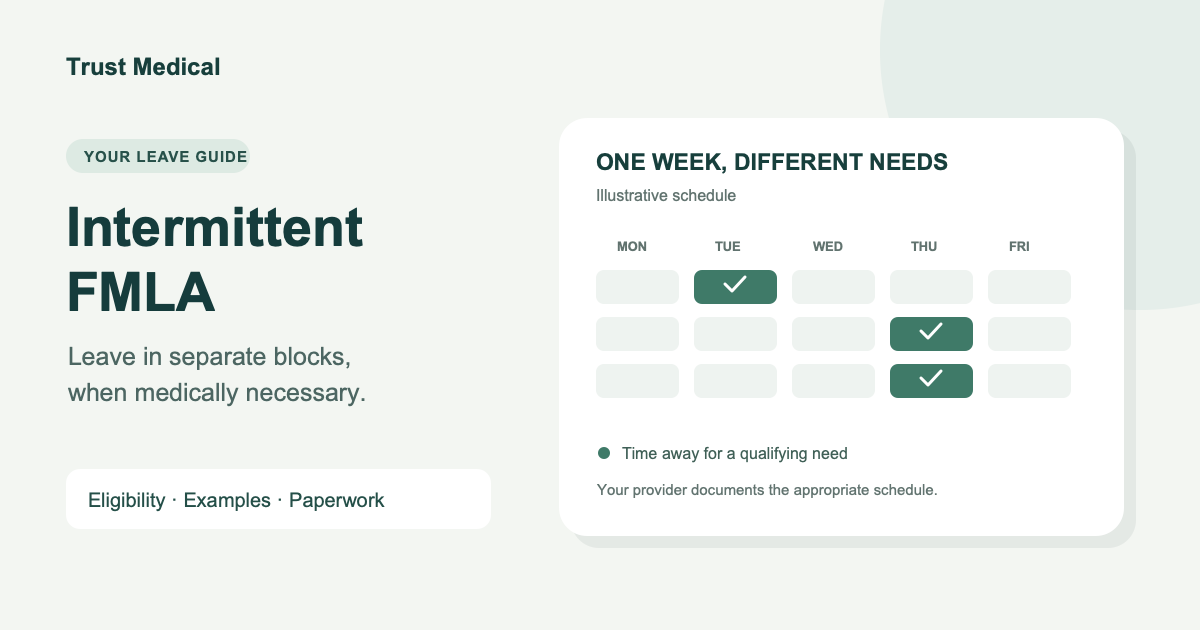
Intermittent FMLA is job-protected leave taken in separate blocks of time for one qualifying reason, instead of one continuous absence. You might miss a few hours for a treatment, or a day or two when a condition flares up, and keep working the rest of the time.
FMLA leave can be taken three ways:
- Continuous leave: one unbroken block, such as several weeks after surgery.
- Intermittent leave: separate blocks of hours or days for the same reason.
- Reduced schedule: fewer hours per day or days per week for a period of time.
Who can use intermittent FMLA
Intermittent or reduced-schedule leave is available when it is medically necessary for your own serious health condition or to care for a spouse, child, or parent with one. It can also be used for some military family leave reasons. Leave to bond with a new child can be taken intermittently only if your employer agrees. DOL Fact Sheet #28.
You also need to be eligible. In general, you have worked for a covered employer for at least 12 months, worked at least 1,250 hours in the 12 months before leave, and work at a location where your employer has at least 50 employees within 75 miles. Special rules apply to some workers, so confirm with HR.
Intermittent FMLA examples and how leave is counted
These examples are illustrations, not promised schedules. Your actual leave depends on your certification and your employer's approval.
- Recurring treatment: an employee receives an infusion every three weeks and misses half a day each time.
- Episodic condition: an employee with migraines may miss a day when an episode makes work impossible, a few times a month.
- Caring for a family member: an employee drives a parent to scheduled chemotherapy appointments.
How intermittent leave is counted
Only the time you actually take off counts. Your employer tracks it in the smallest increment it uses for other leave, as long as that is no more than one hour.
For most qualifying reasons, you get up to 12 workweeks total in the applicable 12-month leave year, not 12 weeks per episode. Military caregiver leave has a separate entitlement of up to 26 workweeks in a single 12-month period.
The number of hours depends on your normal workweek. For example, 12 weeks equals 480 hours for someone who usually works 40 hours a week and 240 hours for someone who works 20. If your schedule varies so much that your expected hours cannot be determined, the employer generally uses a weekly average of hours scheduled over the 12 months before leave, including hours for which you took leave. DOL Fact Sheet #28I.
Worked example: frequency, duration and your leave balance
This example is illustrative, not a recommended schedule or a promise of approval. Suppose you normally work 40 hours per week and have your full 480-hour FMLA entitlement available. A provider estimates up to two episodes per month lasting up to four hours each, plus one two-hour treatment appointment.
- Frequency: up to two episodes per month, plus the appointment.
- Duration: up to four hours per episode and two hours for the appointment.
- Actual time used: if you miss three hours for each of two episodes and two hours for the appointment, that month uses eight hours. Assuming no other FMLA leave, 472 hours remain.
The estimate describes the expected medical pattern; it is not a monthly allowance. Only leave actually taken counts against the balance. An absence within the estimate must still be for the qualifying reason and reported under your employer's procedures. If absences exceed the estimate, contact HR and your provider; they are not automatically unprotected, but a significant change may prompt recertification.
Planned treatment
For foreseeable treatment, make a reasonable effort to schedule appointments so they do not unduly disrupt your employer's operations. For planned intermittent leave, your employer may temporarily transfer you to an available position with equivalent pay and benefits that better fits the schedule.

How to apply for intermittent FMLA
Step 1: Confirm eligibility and the reason for leave
Ask HR whether you meet FMLA eligibility rules, how your employer measures its 12-month leave year, and which forms it uses. Be clear about the reason: your own condition, a family member's condition, or another qualifying reason.
Step 2: Notify your employer
Give enough information for your employer to recognize that the leave may qualify under FMLA. You do not need special wording. When leave is foreseeable, give 30 days' notice if practicable. Otherwise, give notice as soon as practicable and follow your employer's usual call-in procedures unless unusual circumstances prevent it. DOL guide to talking with your employer about leave.
Step 3: Get the certification form
Your employer may require medical certification. DOL's optional forms are WH-380-E for your own condition and WH-380-F for a family member's condition. Employers may use their own form if it asks only for permitted information. You generally have at least 15 calendar days to return it, and more time if you cannot meet the deadline despite good-faith efforts. DOL Fact Sheet #28G.
Step 4: Have a provider complete it
The provider explains why intermittent or reduced-schedule leave is medically necessary and estimates the schedule. For planned treatment, that means dates or frequency. For episodes that cannot be predicted, the provider estimates how often they may occur and how long they may last.
Step 5: Return the form and follow up
Keep a copy. If the certification is incomplete or insufficient, your employer must tell you in writing what is missing and generally give you at least 7 calendar days to fix it. Your employer, not the provider, decides whether the leave is designated as FMLA.

What your certification should include
Bring the employer's form, a description of your job duties, and relevant records. A complete certification usually covers:
- When the condition started and how long it is expected to last.
- Medical facts that support the need for leave. A diagnosis is not required.
- Why intermittent or reduced-schedule leave is medically necessary.
- Expected dates and frequency of planned treatment.
- Estimated frequency and duration of flare-ups or episodes, if any.
- For a family member, the care you will provide.
DOL explains what certification may include in Fact Sheet #28G. For more help with forms, see how to get your doctor to fill out FMLA paperwork.
How Trust Medical can help
If you need certification for your own condition, Trust Medical's FMLA evaluation includes an intake and a video visit with a licensed provider, who decides whether certification is medically appropriate. Trust Medical does not provide ongoing treatment and cannot guarantee your employer will approve leave. For a family member's condition, the certification usually comes from that person's treating provider.

Using approved intermittent leave
- Call in each time. Follow your employer's usual call-in procedures, such as who to contact and by when, and say the absence relates to your approved FMLA leave. If you skip those procedures without unusual circumstances, FMLA protection for that absence can be delayed or denied.
- Track your hours. Keep your own log: date, start and end time, whether it was an episode or an appointment, and who you notified. Compare it with your employer's FMLA balance from time to time.
- Talk to HR if things change. If episodes become more frequent or last longer than certified, your employer may ask for recertification. Your provider may need to update the estimate.
Correcting a form vs. updating it after a change
- Clerical correction: a wrong date, a missed box, or an estimate your employer cannot read. Ask the provider who signed the form to correct or clarify it, and include your employer's written deficiency notice if you received one. You generally have at least 7 calendar days to cure.
- Changed clinical pattern: episodes now happen more often, last longer, or need different treatment. That is not a typo. The provider needs to reassess before updating frequency or duration, and your employer may request recertification, with at least 15 calendar days to return it, unless completion is impracticable despite diligent, good-faith efforts. Do not ask a provider to change the numbers without that review.
Pay and other benefits
FMLA is unpaid. You may choose, or your employer may require you, to use accrued paid leave. State paid leave programs and disability benefits have their own eligibility rules. Intermittent absences do not automatically qualify for short-term disability, which may have a waiting period and its own definition of disability. See how to get paid during FMLA. For mental health conditions, see FMLA for anxiety and mental health.
Ready to start? Start an FMLA evaluation for your own condition.
Get help with intermittent FMLA certification





Still have questions? Find answers here:
For most qualifying reasons, up to 12 workweeks total in the applicable 12-month leave year, not 12 weeks per episode. The hours depend on your normal schedule: for example, 480 hours for someone who usually works 40 hours a week. Military caregiver leave has a separate entitlement of up to 26 workweeks in a single 12-month period. DOL Fact Sheet #28I.
Yes, if your certification supports it. Your provider estimates how often episodes may happen and how long they may last. When an episode occurs, notify your employer as soon as practicable and follow its usual call-in procedures.
Generally yes. Approved intermittent leave does not replace your employer's normal call-in rules unless unusual circumstances prevent you from following them. Mention that the absence relates to your approved FMLA leave.
FMLA itself is unpaid. You may choose, or your employer may require you, to use accrued paid leave during FMLA, and state programs or disability benefits have their own rules. See our guide to pay during FMLA.
Yes, when it is medically necessary to care for a spouse, child, or parent with a serious health condition. The family member's provider usually completes the certification, often on form WH-380-F. Leave to bond with a new child can be intermittent only if your employer agrees.
Sometimes. Generally, no more often than every 30 days and only in connection with an absence. If your certification states a minimum duration longer than 30 days, your employer generally waits until it expires, but it may request recertification every six months in connection with an absence. It can ask sooner if circumstances change significantly, you request an extension, or it receives information that casts doubt on the certification. DOL Fact Sheet #28G.
250K+

Money Back Guarantee!
Related posts